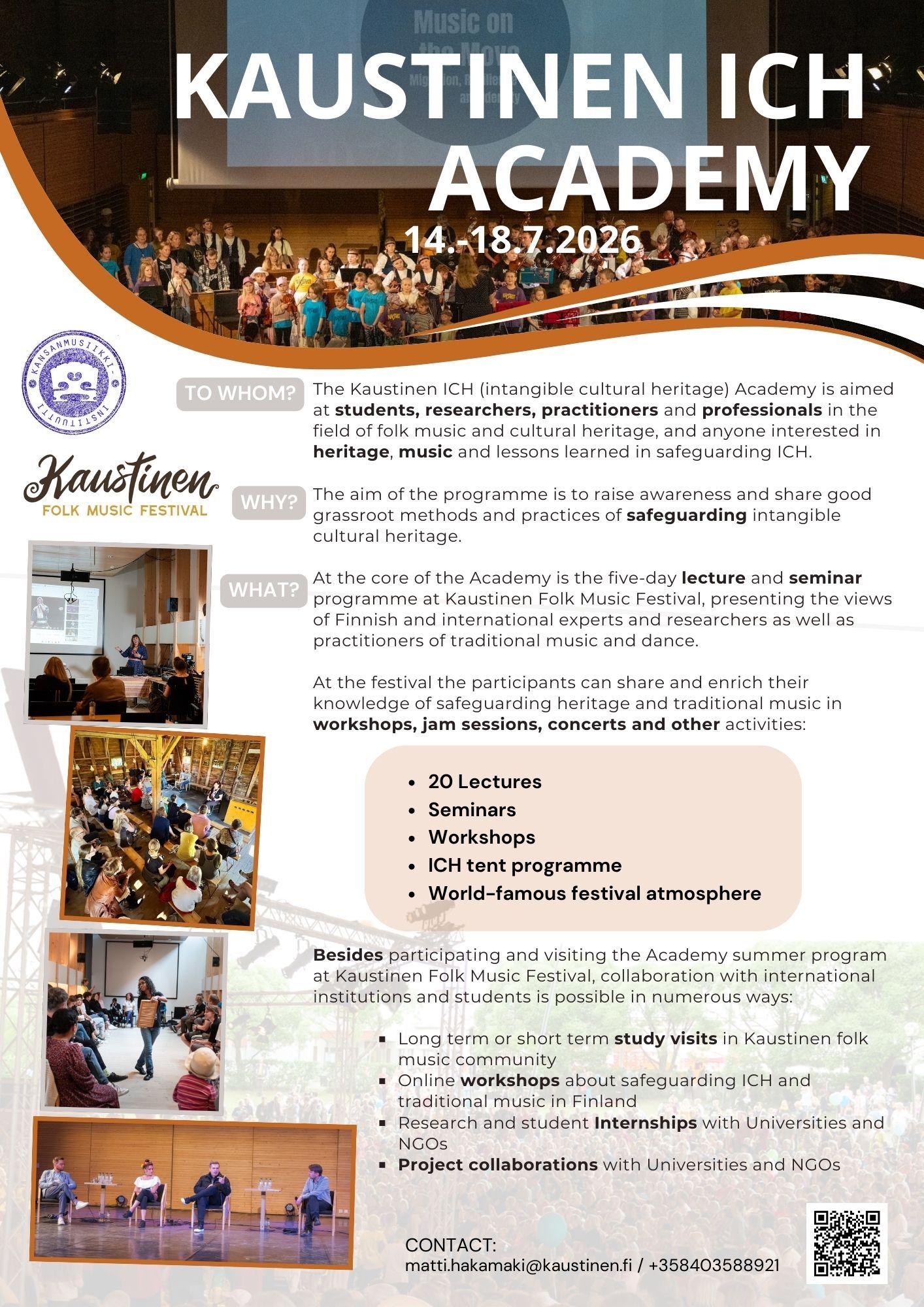
KAUSTINEN ICH ACADEMY 2026
The Kaustinen ICH (Intangible Cultural Heritage) Academy is organised in Kaustinen, Finland, from 14 to 18 July 2026, in the unique context of the Kaustinen Folk Music Festival. The programme offers an opportunity for the participants to share and expand their knowledge of safeguarding intangible cultural heritage and traditions of music and dance.
Founded in 1968, the Kaustinen Folk Music Festival is the largest folk music event in Finland and one of the most prominent in Europe, bringing together thousands of performers and tens of thousands of visitors annually. At its heart lies the vibrant local fiddle tradition, inscribed on UNESCO’s Representative List of the Intangible Cultural Heritage of Humanity in 2021, making the festival an ideal setting for immersive ICH learning.The Kaustinen ICH Academy is organized in collaboration with, among others, the University of the Arts Helsinki and Centria University of Applied Sciences.
Place: Folk Art Centre, Kaustinen
Address: Jyväskyläntie 3, Kaustinen
(seminar on Saturday will also be streamed)
Programme
Tuesday 14.7.
Lectures 10:00–11:30. Museum hall
Following the launch of the Kaustinen ICH Academy, we will hear about how the intangible cultural heritage practices not only unite people, but can also be a source of non-belonging, as well as research on the Näppäri pedagogy, music education rooted in folk music.
10.00 Kaustinen ICH Academy welcoming words
10.15 Elo-Hanna Seljamaa (Estonia): Intangible cultural heritage and differential identity
11.00 Neea Lamminmäki: The politics of inclusive intergenerationality in music education: Case Näppärit
Lectures 14:00–15:00. Museum hall
The lectures will examine ways to safeguard intangible cultural heritage in situations where a community lives in a new country and environment rather than in its original homeland, and will explore how the concept of folk music has been understood at different times.
14.00 Pär Moberg (Sweden): Safeguarding cultural heritage in diaspora
14.30 Heidi Henriikka Mäkelä and Outi Valo: Perceptions of Folk Music in Finland: towards ICH and communities in the 2020s
[In the Seminar at 16.00–18.30 in the Museum hall (Visio2030 for the Folk Music and Folk Dance Sector) the working language will be Finnish.]
Wednesday 15.7.
Lectures 10:00–11:30. Museum hall
What happens when the subject of the fieldwork is inscribed on the international list of Intangible Cultural Heritage? And how has Taiwanese Hakka traditional music been shaped by processes of heritagisation? The day will begin with a presentation of the ICH EDU North project.
10.00 Project presentation: ICH EDU North
10.15 Anda Beitāne (Latvia): From the Field to the ICH List: Singing with a Half-Part in Northern Latgale
11.00 Hsinwen Hsu (Taiwan): The Heritagization of Hakka Music in Taiwan: Processes and Transformations
Lectures 14:00–15:00. Museum hall
A discussion on Örebro University’s experiences with integrating living heritage into its curriculum, as well as the role of the Kaustinen Folk Music Festival as a melting pot for living heritage.
14.00 Hans Balsted (Sweden): The value and importance of ICH-based knowledge for the School of Music, Theater and Art, Örebro University
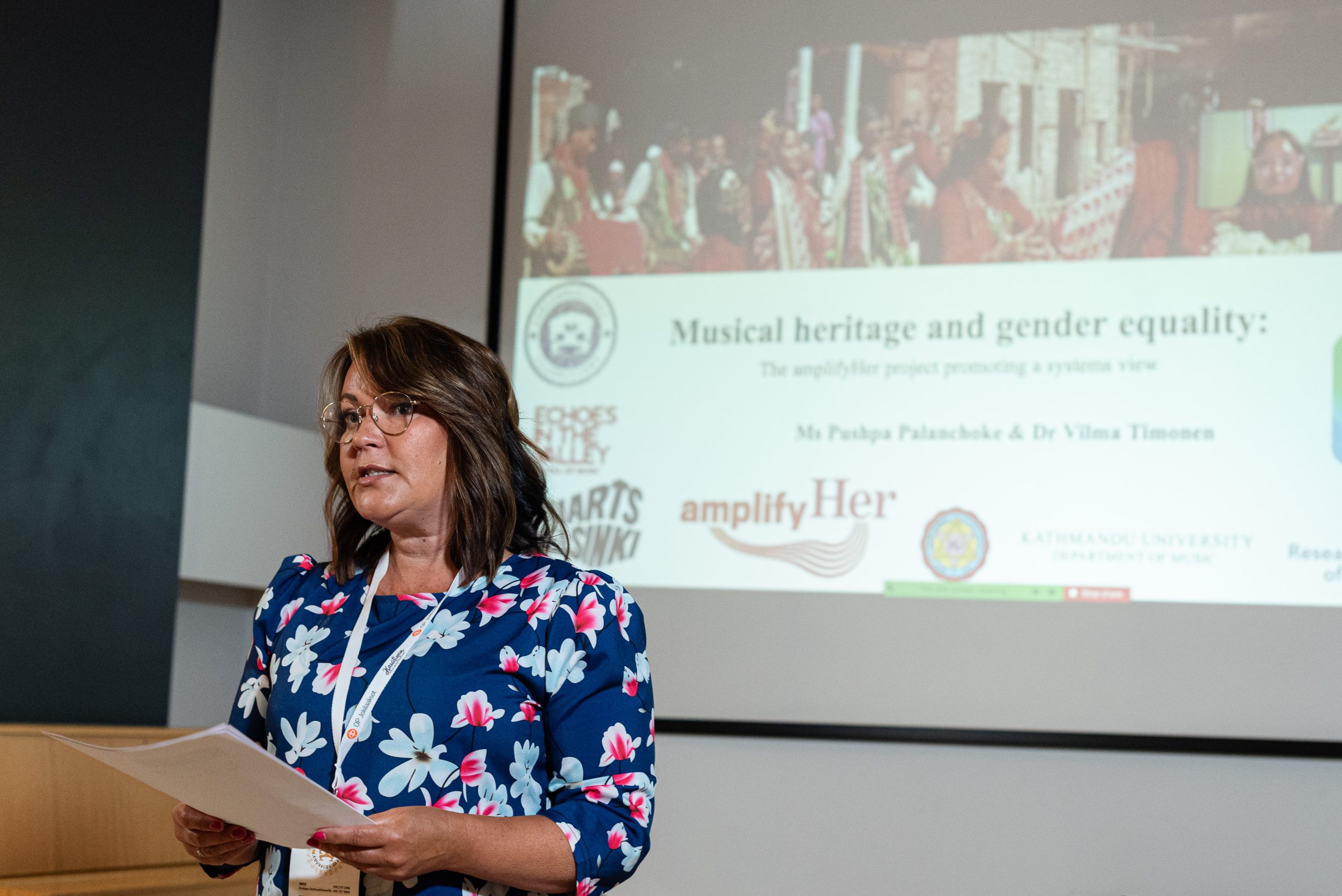
14.30 Anne-Mari Hakamäki and Vilma Timonen: Kaustinen Folk Music Festival as public sphere for ICH ecology
Thursday 16.7.
Lectures 10:00–11:30. Museum hall
The Syvälle collective, consisting of five researchers, explores the secrets of improvisation. The President of the Sámi Parliament of Finland introduces the history and significance of joik.
10.00 Kristiina Ilmonen & the Syvälle Collective: Deep Encounters – New Perspectives on Improvisation in Dialogue with Artists
11.00 Pirita Näkkäläjärvi: How Sámieatnan duoddariid chose itself as the Sámi national yoik
Lectures14:00–15:00. Museum hall
How is music created amid the conflicting pressures of different cultures and traditions, and what exactly does the world-famous Georgian traditional music encompass?
14.00 Moskitto Bar (Canada):Culture, Diversity and Music Making
14.30 The Dialectal Diversity of Traditional Georgian Music
Seminar 17:00–19:30. Museum hall
No Makers, No Music – The Future of Traditional Instrument Making
The seminar will explore the current state and future prospects of traditional instrument making. Without makers, there are no instruments—and without instruments, there is no folk music. How could the concept of living heritage and the 2003 UNESCO Convention offer new ways to highlight the significance of the instrument-making in Finland, the Baltic countries, and the Nordic countries? What kinds of international networks are needed, and how should education in this field be organized?
Friday 17.7.
Lectures 10:00–11:30. Museum hall
The morning session will focus on the role of municipalities and cities in safeguarding living heritage, traditional musical instrument-making in South Korea and Finland’s living heritage inventory related to sustainability.
10.00 Hanna Schreiber (Poland): Municipalities, Communities and Living Heritage: What Can We Learn from Warsaw and Kaustinen?
10.30 Jinyoung Seo (Republic of Korea): Akgijang, From Wood to Resonance
11.00 Leena Marsio: Inventorying living heritage – a look into sustainability perspectives
Lectures 14:00–15:00. Museum hall
The lectures will feature Astorian folk music and introduce the Norwegian Crafts Institute, a Norwegian organization accredited under the 2003 UNESCO Convention
14.00 Deira (Spain): Asturian folkmusic as Celtic Heritage
14.30 Eivind Falk (Norway): Norwegian Crafts Institute
[In the Seminar at 12:00–14.30 in the Kaustinen-hall (Place, Heritage, and Sustainability – Cultural Security of Supply in the Finland) the working language will be Finnish.]
Saturday 18.7.
Seminaari 11:00–13:30. Kaustinen sali
KAUSTINEN INTANGIBLE CULTURAL HERITAGE SEMINAR 2026: Festivals – Living Platforms for the Safeguarding of ICH
Seminaarissa tarkastellaan tapahtumien roolia aineettoman kulttuuriperinnön suojelun alustoina ja välineinä. Seminaarissa nostetaan esiin, mitä Unescon 2003 sopimus ja elävän perinnön käsite voivat tarjota musiikkitapahtumille — mukaan lukien laajemman ja moninaisemman yleisöpohjan kiinnostuksen lisääminen sekä festivaalien yhteiskunnallisen merkityksen vahvistaminen. Seminaarin Keynote-puheenvuoron pitää professori Hanna Schreiber (Puola) ja Kaustisen kansanmusiikkijuhlien ohjelmajohtaja Anne-Mari Hakamäen vetämässä paneelissa aiheesta keskustelevat Songlines-lehden pitkäaikainen toimittaja Jo Frost (Iso-Britannia), muusikko Freddy Clue (Ruotsi), Hangveto-järjestöjön johtaja Balázs Weyer (Unkari) sekä ohjelmapäällikkö Johanna Eurakoski Maailma kylässä -festivaalista. Musiikkimakupaloista vastaa muun muassa Kaustisen Näppärit.
Seminaari striimataan Kansanmusiikki-instituutin Youtube-kanavalla @kansanmusiikki-instituutti898. Seminaarikieli englanti. Linkki seminaariin: https://youtube.com/live/rLOLx
Seminaariohjelma:
11.00 Matti Hakamäki: Welcome to the seminar
11.05 Choirs of the University of Chanting (GE)
11.15 Hanna Schreiber (PL) – Living Heritage and the Paradox of Participation: Are our Festivals Democratic Enough?
11.50 Children group Näppärit from Kaustinen
12.00 Panel Discussion – Festivals and Safeguarding of ICH. Programme Director Anne-Mari Hakamäki will host a panel discussion where musicians, festival organizers and experts from different fields reflect on the seminar theme. The panelists are musician Fredy ”Clue” Lundh (SE), Balázs Weyer (HU), Jo Frost (UK) and Johanna Eurakoski.
13.10 Questions and answers
13.25 Closing music – TBA
For Erasmus-partners:
The programme is organised as an ERASMUS+ BIP (Blended Intensive Project) in collaboration with Centria University of Applied Sciences and a network of European partners, including University of Warsaw, Lund University, The Stockholm University College of Music Education, University of Tartu, and Jāzeps Vītols Latvian Academy of Music.
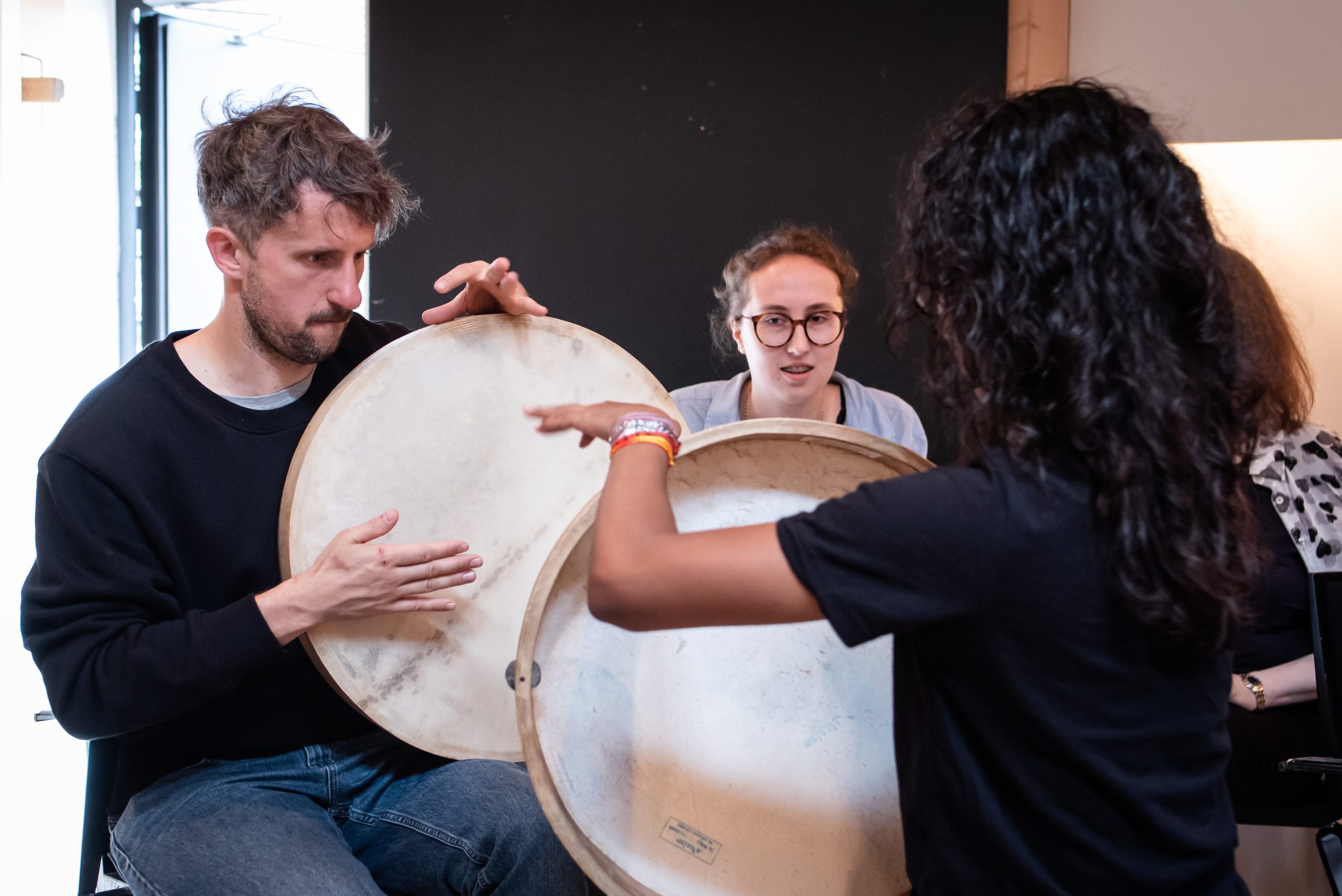
The programme offers lectures, seminars, workshops, and participation in the festival’s dedicated ICH tent activities, all within a unique, practice-based learning environment. Students will engage directly with living heritage through performances, jam and dance sessions, and interactive workshops, highlighting grassroots methods of safeguarding and transmitting ICH.
Nominated students from Erasmus BIP partner organisations will receive free entry to the Kaustinen Folk Music Festival and can participate for example to following workshops (optional):
Tuesday 14.7.:
11:30-13.00 Jamworkshop (with instruments), Mondo tent.
11:30-13.00 Danceworkshop, Maunon makasiini -stage. Kataja’s Jam Dance
Workshop: Add more Moves to Your Free-Style Dancing. Workshop on the possibilities of dances in a small place without compromising on the swing.The workshop is for dancers who already know the basic steps of folk couple dances.
Wednesday 15.7.:
11:30-13.00 Jamworkshop (with instruments), Mondo tent. Teacher: Johanna-Adele Jüssi (Norway).
11:30-13.00 Danceworkshop (dance), Kallio Club. Kataja’s Jam Dance Workshop: Add more Moves to Your Free-Style Dancing. Schottis workshop. The workshop is intended thos who already know the basic steps of the Schottis.
Thursday 16.7.:
11:30-13.00 Jamworkshop (with instruments), Mondo tent. Teachers: Ethno Finland 2026.
11:30-13.00 Danceworkshop (dance), Kallio Club. Kataja’s Jam Dance Workshop: Add more Moves to Your Free-Style Dancing.
Friday 17.7.:
11:30-13.00 Jamworkshop (with instruments), Mondo tent. Teachers: Trolska Polska (Denmark)
11:30-13.00 Danceworkshop (dance), Kallio Club. Kataja’s Jam Dance Workshop: Add more Moves to Your Free-Style Dancing. Waltz workshop. The workshop is intended thos who already know the basic waltz steps.
We are looking for Erasmus-partners also for the year 2027!
Link to the whole festival programme (separate tickets):
Kaustinen Folk Music Festival: https://kaustinen.net/en/aikataulu-2026/
Programmes from the previous years:
Kaustinen ICH Academy programme from the year 2025
– Recordings from the year 2025 on YouTube
Kaustinen ICH Academy programme from the year 2024
– Recordings from the year 2024 on YouTube